
Commercial gas work in the capital is rarely simple. Plant rooms sit in basements or on roofs, pipework runs through shared risers, and access often has to be booked weeks ahead.
Gas Main Installation supports businesses, contractors and building managers with commercial gas installation, repair, tightness testing, purging, commissioning and decommissioning. Our engineers are Gas Safe registered and work on commercial and industrial systems.
This page explains the work we carry out, the buildings we see most often, and who you may need to speak to before a project starts.
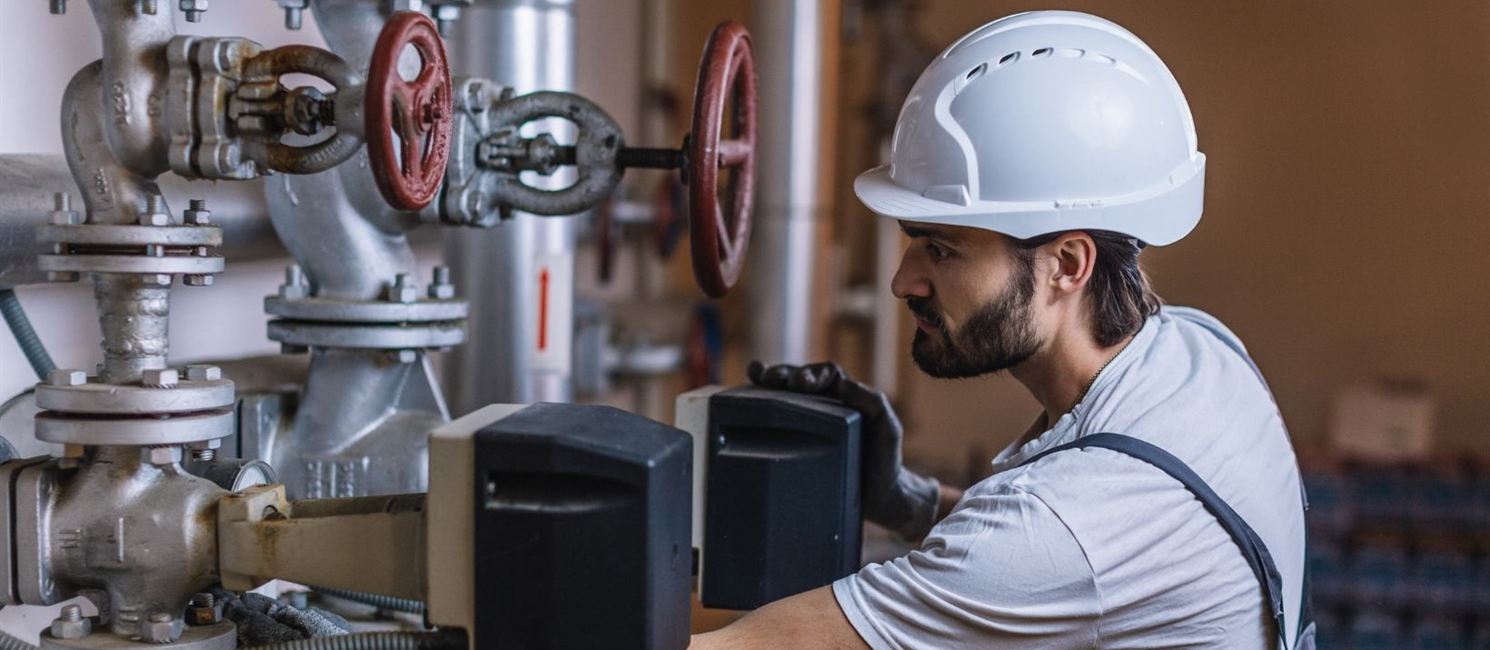
What commercial gas work do we carry out?
- Installation of commercial gas pipework, appliances and plant
- Tightness testing and strength testing of new and existing pipework
- Gas purging, including nitrogen purging on larger pipework
- Commissioning of new systems and recommissioning after shutdowns
- Decommissioning and making safe of redundant pipework
- Leak investigation, fault finding and emergency repairs
- Gas safety testing and commercial gas certificates
Testing and purging on commercial pipework is carried out to the relevant IGEM standards. This is normally IGEM/UP/1, or IGEM/UP/1A for smaller low pressure installations.
Which London buildings need gas testing and purging?
Offices and mixed-use towers
Buildings in the City, Canary Wharf and the West End often have boilers or combined heat and power plant in a basement or rooftop plant room. Long vertical risers mean larger pipe volumes, which changes how a purge is planned and where the vent point goes.
Restaurants, hotels and commercial kitchens
Soho, Shoreditch, Covent Garden and the hotel districts around Paddington and King's Cross see constant kitchen fit-outs. New pipework has to be tested and purged before any appliance is commissioned.
Most commercial kitchens also need a working interlock between the ventilation system and the gas supply. We check this as part of commercial catering work.
Hospitals, universities and public buildings
Large estates often have long site-wide gas mains, some of them decades old. We isolate and test in sections so the rest of the site can stay live.
Industrial and food production sites
Park Royal, Brimsdown in Enfield, Purley Way in Croydon and the Thames-side estates in Barking and Dagenham all have process burners, ovens and steam boilers that depend on a sound gas supply.
Planning gas work in a crowded city
A few practical points shape almost every job here.
Venting. Purged gas must be released to a safe place outdoors, away from windows, air intakes and ignition sources. On a tight London street this often decides the purge method and the time of day the work is done.
Access. The Ultra Low Emission Zone covers every borough, and the Congestion Charge applies in the centre. Deliveries, parking and loading for materials need planning in advance, particularly on red routes.
Shutdown windows. Many buildings only allow gas shutdowns overnight or at weekends. Our team is available seven days a week, so testing can be fitted around trading hours.
Listed buildings. External pipe routes, flues and meter housings on listed buildings or in conservation areas may need consent from the borough planning department.
Who looks after roads and street works?
There is no single highways department. Each of the 32 boroughs, along with the City of London Corporation, is the highway authority for its own roads. Transport for London manages the red routes, and National Highways looks after the M25 and the motorways.
Street works are coordinated through the London Permit Scheme. If your project involves digging in a public road or footway, for example to lay underground gas pipework across a pavement, a permit or a section 50 licence is normally needed from the relevant authority.
Work on private land does not need a highway permit, but a utility search is still essential before any excavation.
Who owns the gas pipe?
North of the Thames the gas network is generally operated by Cadent. South of the river it is generally SGN. The network owns the service pipe up to the emergency control valve.
New connections, supply upgrades and meter changes are arranged through the network operator or your gas supplier. Pipework after the meter belongs to the building owner, and that is where our engineers work.
If you smell gas, call the National Gas Emergency Service on 0800 111 999 straight away.
When is a tightness test needed?
A tightness test confirms that pipework is sound at its operating pressure. It is normally carried out:
- Before new pipework is put into service
- After any alteration or extension
- When there is a smell of gas or a suspected leak
- Before gas is restored after a long shutdown
- As part of a planned gas safety inspection
New pipework is also strength tested at a higher pressure before it is connected.
Commissioning and decommissioning
Once a test has passed, air is purged from the pipework and replaced with gas. Appliances are then set up and checked.
On smaller systems this is done as a direct purge. On larger pipe volumes nitrogen is used first, so that gas and air never mix inside the pipe.
Decommissioning is the same process in reverse. Gas is purged out, the pipework is cut back, capped, labelled and recorded.
This is common in London strip-outs, where a floor is moving to electric heating or a kitchen is being removed. Live dead legs left above ceilings are one of the most frequent problems we find in refurbished buildings.
Areas and postcodes we cover around the capital
We cover all central postcode areas, including EC, WC, E, N, NW, SE, SW and W, along with the outer boroughs in BR, CR, EN, HA, IG, KT, RM, SM, TW and UB.
Gas Main Installation is not limited to central London. Our engineers also work in Croydon, Bromley, Ealing, Harrow, Enfield, Barking, Romford, Kingston upon Thames and Hounslow. We cover towns just outside the M25 too, such as Watford, Dartford, Slough and Epsom.
We provide commercial gas services across the UK, so if your site is not listed here, it is still worth asking.
Discuss your London project with us
Whether you are a contractor handing over a new fit-out, a facilities manager planning a shutdown, or a business owner who needs a gas system tested, we can help.
Call 08000 855 077 or contact Gas Main Installation with your site address, a short description of the pipework and your preferred dates. We will come back to you with a clear plan and a free, no-obligation quote.